Five Things Intercessors Should Know About Islam’s Growing Influence in America
 5,675 Views
 Comments (4)
 Share (56)
Print
Share (56)
Print
Education Dept. Presses Blue States to End Trans Secrecy Policies
DOJ Exposes $350 Million Fraud Sweep in Southeast
Louisiana Passes Sweeping Bills to Counter Foreign Influence
Newly Released Audio Revives Questions About Biden’s Decline
Five Things Intercessors Should Know About Islam’s Growing Influence in America
5,675 Views
Comments (4)
Share (56)
Print
 I Prayed
have prayed
I Prayed
have prayed
As concerns grow over the expansion of Islam in America, Intercessors for America’s Pray with America’s Leaders welcomed national security expert Frank Gaffney to discuss what he believes intercessors should understand about the movement’s growth and its implications for the nation. Throughout the conversation, Gaffney and IFA Chief Program Officer Kris Kubal urged intercessors to respond not with fear, but with informed prayer and civic engagement.
Get prayer updates from IFA.
Gaffney, who served as Assistant Secretary of Defense under President Ronald Reagan, framed the discussion around five key ideas he believes Americans need to understand. While acknowledging that Muslims are not all the same, he argued that Americans should pay close attention to the political and legal aspects of Sharia and the efforts of organizations seeking to expand its influence in the United States.
1. The Growth of Islam in America Is Real
Kubal opened by noting that many Americans have observed an increase in mosques, Islamic schools, and Muslim political activism across the country. Gaffney argued that this growth is part of a broader long-term strategy rather than isolated local developments.
He cautioned viewers not to assume that what they see today represents the final objective, saying that movements built around Sharia often become more assertive as their influence grows. According to Gaffney, intercessors should pay attention to how organizations are building infrastructure and seeking positions of influence in local communities.
2. Religious Freedom and Sharia Are Different Questions
One of the discussion’s central themes was the distinction between religious liberty and political ideology. Gaffney emphasized that Americans are free to practice their faith under the First Amendment, but argued that any political or legal system that seeks to replace constitutional government deserves careful scrutiny.
The conversation also explored whether Sharia is compatible with the U.S. Constitution. Gaffney contended that the two systems are fundamentally incompatible because both claim ultimate authority. Kubal reinforced that point by quoting President Dwight D. Eisenhower, who warned that constitutional freedoms should never be used as a shield for movements seeking to destroy those same freedoms.
3. Influence Often Extends Beyond the Mosque
Kubal and Gaffney also discussed what they described as efforts to build influence beyond houses of worship. They pointed to participation in local government, zoning boards, schools, healthcare systems, and community organizations as examples of areas where intercessors should remain engaged and informed.
Gaffney referenced the Muslim Brotherhood’s “Explanatory Memorandum,” a document introduced as evidence during the Holy Land Foundation terrorism financing trial, arguing that it outlines a long-term strategy for expanding Islamic influence in North America. The speakers encouraged viewers to become familiar with these ideas rather than dismissing them as conspiracy theories.
4. Everyday Issues Can Have Larger Implications
The webcast also examined halal food certification, which Gaffney argued is more than simply a dietary preference. He claimed that certification systems can generate financial support for organizations advancing Islamic causes and encouraged viewers to understand where those systems operate.
The discussion then turned to reports of practices such as female genital mutilation, child marriage, and human trafficking occurring within isolated communities. Gaffney argued that Americans should not assume such abuses only happen overseas, while Kubal emphasized the importance of protecting women, children, and vulnerable communities through both prayer and civic awareness.
5. Intercessors Must Pray and Stay Engaged
The conversation concluded with a call to action. Gaffney urged intercessors to educate themselves, support organizations working on these issues, and pray that America would preserve its constitutional freedoms. Kubal encouraged viewers to research what is happening in their own communities, download IFA’s resource Islam and the Spirit Behind It, participate in IFA Action initiatives, and remain active in prayer.
Kubal closed the webcast by reminding intercessors that spiritual battles require spiritual responses. She called on intercessors to pray for discernment, courage for elected officials, protection for America’s constitutional foundations, and wisdom for intercessors seeking to faithfully engage the culture around them.
You can watch this webcast in the embedded player below.
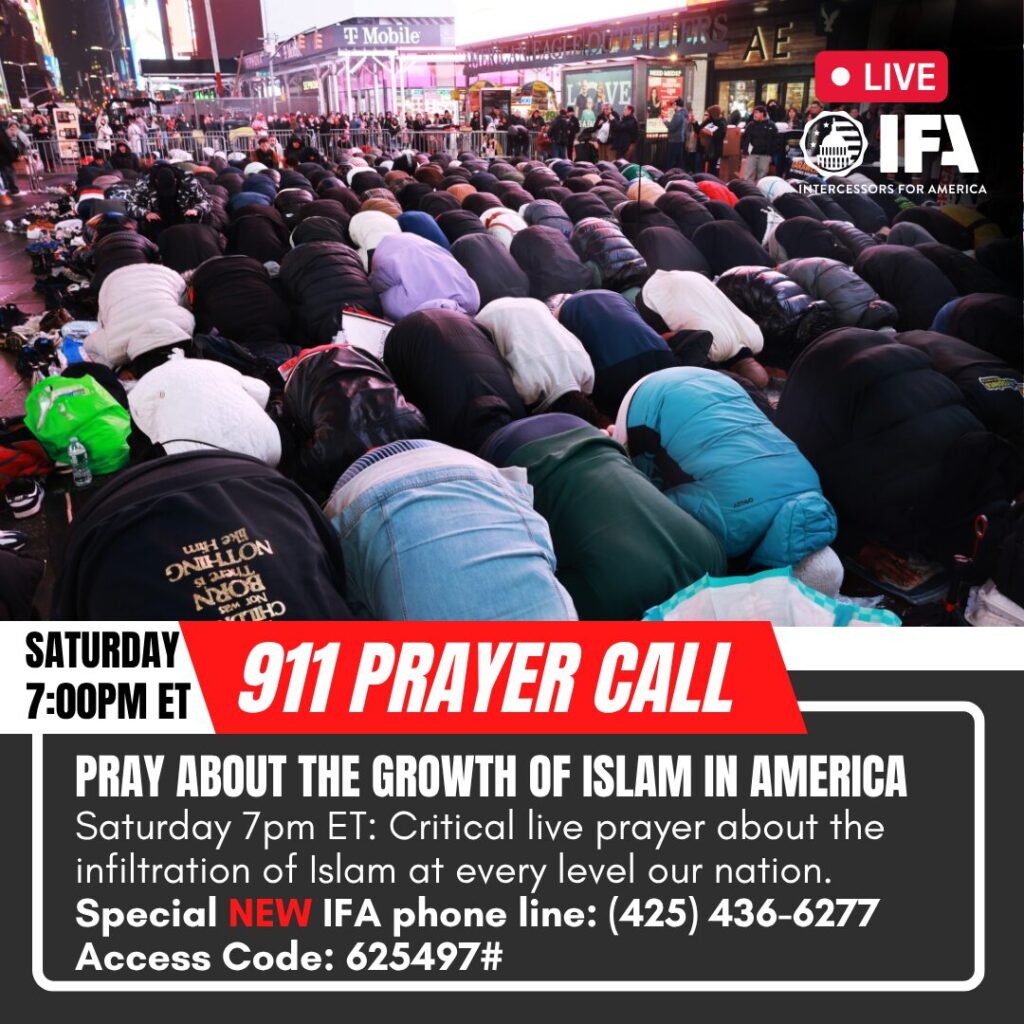
Additionally, if you looking for ways to stay engaged, IFA will be leading a 911 prayer call about Islam tonight at 7 PM ET. If you are interested in joining, you can find more information in the image below.
How are you praying for America as Islam continues to expand its influence? Share your prayers and any relevant scriptures below.
(Photo Credit: Dane Hillard – originally uploaded to Flickr as Islamic Center of America, CC BY 2.0, https://commons.wikimedia.org/w/index.php?curid=8493981)
 Comments (4)
 Share (56)
Post A Prayer
Print
I Prayed
have prayed
Post A Prayer
Share (56)
Post A Prayer
Print
I Prayed
have prayed
Post A Prayer


Related Content
Islamic Mosques and Cultural Centers Emerge as Public Schools Shutter...
I Prayed
Who Are the Democratic Socialists of America?
I Prayed


Partner with Us
Intercessors for America is the trusted resource for millions of people across the United States committed to praying for our nation. If you have benefited from IFA's resources and community, please consider joining us as a monthly support partner. As a 501(c)3 organization, it's through your support that all this possible.



We use cookies to ensure that we give you the best experience on our website. If you continue to use this site we will assume that you are happy with it. Privacy Policy



Comments
Amen in Jesus name
DEAR LORD GOD
PLEASE DESTROY ISLAM FROM WITHIN.
I ASK IN JESUS’ NAME
AMEN
There are Muslims that live across the hall from me in the apartment complex! I have USA decorations on the door to my apartment!
we as intercessors have to keep our prayers on the gas!!! dont stop millions of lives are at stake over this..its not just ” they are nice people” most are but its the principles they hold fast to ,howbeit nice they are..God’s Word is truth.. Jesus died for all but they need him too
we have to keep our eye on the prize and pray for them but pray against that spirit of religion they hold fast too
we cant be so accepting of their ideas and mindsets..they are not for us,they are totally against us
new mds are muslims,new mayors,teachers and on and on..please keep your foot on the gas against this in jesus name