BDS Keeps Swinging at Israel’s Economy. Israel Keeps Growing.
 3,411 Views
 Comments (1)
 Share (2)
Print
Share (2)
Print
Trump Wants a 30-Foot Washington Where ‘Infinity’ Stands Today
Who’s Really in Charge of Iran?
Who Attacked America on 9/11? This School Curriculum Won’t Say
Trump Administration Exposes Surge in Dangerous Chinese Activity
BDS Keeps Swinging at Israel’s Economy. Israel Keeps Growing.
3,411 Views
Comments (1)
Share (2)
Print
 I Prayed
have prayed
I Prayed
have prayed
JERUSALEM, Israel – The Boycott, Divestment and Sanctions movement (BDS) has gone on for decades. It’s an effort to put the squeeze on Israel and cause real economic pain. It’s gone from a rallying cry on college campuses to governments around the world. And, while political pressure is growing, the Jewish state’s economy tells a different story.
Connect with others in your state in prayer.
The Boycott, Divestment and Sanctions movement has spent decades trying to make Israel pay a price for its existence. What began as a chant on college quads has grown into government trade restrictions, supermarket protests, and city hall policy in America’s largest city. Yet as the pressure mounts, Israel’s economy keeps expanding, and the contrast is becoming hard to ignore.
From CBN:
The Boycott, Divestment and Sanctions movement (BDS) has gone on for decades. It’s an effort to put the squeeze on Israel and cause real economic pain. It’s gone from a rallying cry on college campuses to governments around the world. And, while political pressure is growing, the Jewish state’s economy tells a different story.
At a grocery store in the U.K. recently, protesters moved down the aisles, removing Israeli products. One protester explained, “Today, we went into this ASDA supermarket, and we took the Israeli goods and the Coca-Cola products from the shelves.”
From Europe to the United States, the campaign against Israel is increasingly becoming an economic one. Several countries have moved to restrict trade specifically with Israeli communities in Judea and Samaria.
The tactics vary by country but the aim is consistent. In New York City, Mayor Zohran Mamdani has said he will not continue the New York-Israel Economic Council established under his predecessor, Eric Adams, and he has publicly backed BDS. At a rally, Mamdani told supporters that three letters were his answer to events in Gaza. The push has also reached electoral politics: Abdul El-Sayed, the Democratic nominee for U.S. Senate in Michigan, has framed his criticism around American aid, arguing that the question of whether Israel has a right to exist is secondary to whether it has a right to U.S. tax dollars.
Dr. Charles Asher Small, executive director of the Institute for the Study of Global Antisemitism and Policy, argues the campaign is part of a broader information war rather than a spontaneous protest movement. He told CBN News that the demonization of Jews and of Israel has a deep pedigree, and he said his greatest concern is the campus. Small pointed to foreign funding of American universities, noting that Qatar, a country of roughly 300,000 citizens, gives more money to U.S. universities than any other nation. Revolutionaries understand, he said, that if you want to change a society you start with its universities and with young people learning to be citizens.
That campus movement has now migrated into politics, and the open question is whether it reaches the boardroom and threatens the international investment that built Israel’s startup economy. Venture capitalist Michael Fertik says that is already underway. He told CBN News that for reasons of politics, propaganda, antisemitism, or simple error, there are people who want to put the brakes on anything connected to Israel, whether that means academic research, collaboration, or investment. Even so, Fertik is expanding his own commitment, saying his firm plans to deploy roughly 15 percent of its current fund into Israeli startups, a tenfold increase over his previous investment.
There is a second side to the equation that boycotters rarely acknowledge. Gabe Groisman, who works with Israeli companies entering the American market, points out that these firms do not merely sell to the United States. They open U.S. operations, hire American workers, and pay American taxes. He said the economic diplomacy runs both ways, and on a recent visit to Tel Aviv he found every company he met was developing technology for the U.S. market. Fertik put it more bluntly: among people who care about business first, the information war is being won by those sympathetic to Israel, because the business case is inarguable.
The numbers bear that out. Even after years of war and regional disruption, the Bank of Israel forecasts 4 percent growth this year and 5.5 percent in 2027. U.S. Ambassador to Israel Mike Huckabee described the resilience he sees walking the streets of Jerusalem, noting that GDP has grown during wartime and that Israel’s stock market is up 100 percent since Oct. 7, 2023. Standing at a lookout point over the city, he said, a visitor sees roughly 300 cranes at work. Countries that are dying, he observed, do not build. They tear things down.
Israel has weathered boycotts before. What remains to be seen is whether the current wave, now amplified by elected officials in American cities and states, can accomplish what earlier campaigns could not.
Scripture is plain that God’s covenant with Israel has never been revoked and that the nations will be judged by how they treat His people (Genesis 12:3; Joel 3:2). The BDS movement is not a neutral exercise in consumer choice. It is an effort to punish the Jewish state for existing, and it has found willing partners in city halls, university administrations, and the investment community. As intercessors, we should note what is happening on campus, where foreign-funded influence has shaped a generation’s view of Israel before those students ever entered the workforce. Praying for the peace of Jerusalem is not a slogan but a command (Psalm 122:6), and it includes praying for those who make decisions about trade, research funding, and investment, that they would resist pressure built on falsehood. The resilience of Israel’s economy is a testimony to the ingenuity God has given that nation, but the real story is spiritual. Faithful intercession matters more than any market report.

How are you praying for Israel? Share your scriptures and prayers in the comments below.
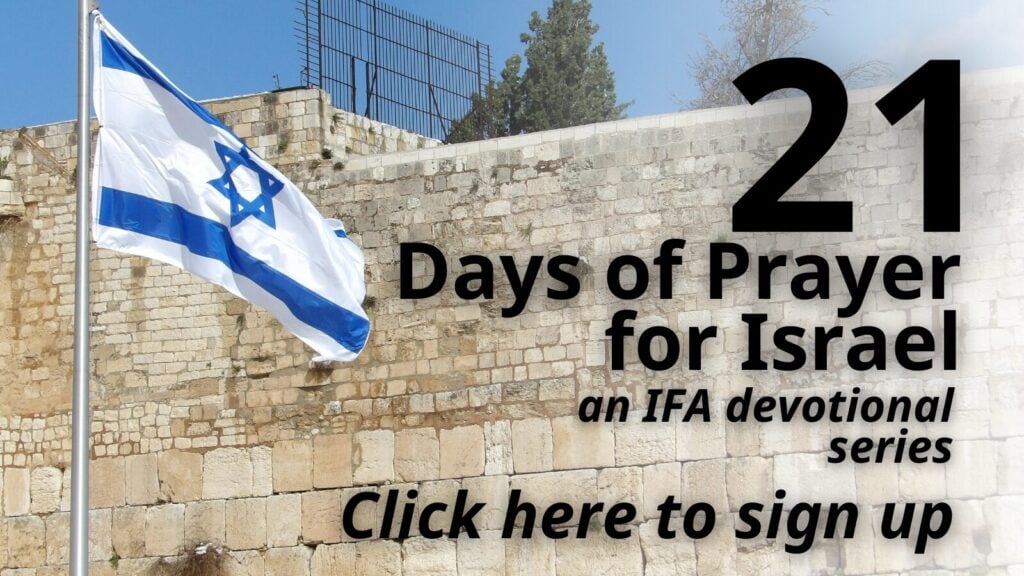
This article was originally published at CBN. Photo Credit: israel flag by Andrew Patrick Photo/Pexels.
 Comments (1)
 Share (2)
Post A Prayer
Print
I Prayed
have prayed
Post A Prayer
Share (2)
Post A Prayer
Print
I Prayed
have prayed
Post A Prayer


Related Content

Talarico draws scrutiny for closed meet-and-greet with Muslim leaders
I Prayed

Intercessors ‘Go Forth’ in Massachusetts
I Prayed


Partner with Us
Intercessors for America is the trusted resource for millions of people across the United States committed to praying for our nation. If you have benefited from IFA's resources and community, please consider joining us as a monthly support partner. As a 501(c)3 organization, it's through your support that all this possible.



We use cookies to ensure that we give you the best experience on our website. If you continue to use this site we will assume that you are happy with it. Privacy Policy



Comments
Resistance to the state of Israel is not new in our generation. Since 1948 it always results in national increase and prosperity for Israel.
The Jews themselves have always suffered greatly because their continued existence testifies to the presence of God and his kingship over the Earth.
I thought the enemy was supposed to be really smart. You would think he would have learned that attacking Israel only benefits Israel!