Who Is Defining the Democratic Party Now?
 13,329 Views
 Comments (34)
 Share (93)
Print
Share (93)
Print
Cyberattacks Target Water Systems Across Multiple States
Are Data Centers a Threat? How Can We Pray?
Mamdani Wants Proof of ID for Grocery Stories, but Not Elections?
Former Trump Ambassador Warns of Rising Authoritarianism in South Korea
Who Is Defining the Democratic Party Now?
13,329 Views
Comments (34)
Share (93)
Print
 I Prayed
have prayed
I Prayed
have prayed
Something significant is happening inside the Democratic Party.
The latest evidence came from Michigan, where Abdul El-Sayed defeated U.S. Rep. Haley Stevens for the Democratic nomination for the U.S. Senate.
This was not a victory in a safely progressive corner of New York City. It happened in Michigan—a presidential battleground—and it came despite the Democratic establishment largely lining up behind Stevens. El-Sayed overcame enormous outside spending against him and defeated a sitting member of Congress. The Associated Press described the result as a major victory for the party’s progressive wing.
Join others crying out to the Lord day and night.
El-Sayed is Muslim. He is also a progressive, but he is not officially a member of the Democratic Socialists of America. However, lining up to support him were several DSA groups.
What is developing inside the Democratic Party is bigger than one organization. There are at least two increasingly visible forces reshaping Democratic politics: the rise of democratic-socialist candidates and activist organizations on one hand, and the growing political representation and organization of Muslims on the other. Sometimes those circles do not overlap. Sometimes they do.
But both are bringing new leaders and constituencies into positions of influence, while a more radical progressive coalition is challenging a Democratic establishment that once exercised much greater control over the party’s nominees and message.
The question is no longer whether these forces exist. The question is: How much of the Democratic Party will they eventually define?
The El-Sayed Victory
El-Sayed’s Michigan victory deserves particular attention.
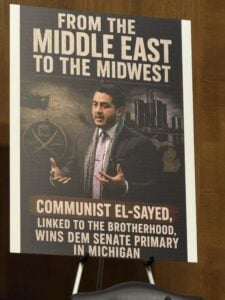
He campaigned on Medicare for All and ending allied status with Israel, and he received support from prominent progressive figures, including Bernie Sanders and Alexandria Ocasio-Cortez. His victory over Stevens came after a costly and intensely contested primary.
Those positions and alliances place him firmly in the party’s progressive insurgent wing, even though he is not formally a DSA candidate.
Yet Democratic primary voters chose him over an established member of Congress.
And Michigan was not an isolated case. In the same primary, state Rep. Donavan McKinney defeated incumbent Democratic Rep. Shri Thanedar in Michigan’s 13th Congressional District.
Something is moving inside Democratic politics.
Then Came Mamdani
Perhaps no political figure better represents the convergence of these emerging forces than New York City Mayor Zohran Mamdani.
Mamdani is both Muslim and a democratic socialist.
His rise from the New York State Assembly to the mayoralty of America’s largest city made him one of the nation’s most prominent democratic-socialist politicians and the first Muslim mayor of New York City.
The significance extends beyond one candidate. The political organization and coalition surrounding Mamdani became a force in subsequent Democratic primaries, providing another test of whether the movement could reproduce its success.
That is the key distinction: a movement becomes politically consequential when it can recruit candidates, organize voters, defeat incumbents, and repeat its victories—not merely when one charismatic candidate wins one election. The differing values and boldness to legislate them grow with each victory.
It would be easy to dismiss democratic socialism as a New York phenomenon. Increasingly, that is difficult to do.
DSA-backed and democratic-socialist candidates have competed and won in state and local contests outside New York as well. The movement’s strategy has emphasized building a pipeline through city councils, state legislatures, and congressional races.
Not every progressive is a socialist, and not every DSA-backed candidate succeeds. But it is hard to ignore the growing trend and momentum these two ideologies have within the Democratic Party.
The shifting infrastructure on the left is real: candidate recruitment, volunteers, small-dollar fundraising, unions, activist organizations, and an increasingly recognizable political message.
A second development deserves examination on its own terms: Muslim Americans are winning elections at increasingly significant levels of government.
The red/green alliance is growing and many of these candidates who are Muslim are also supported by DSA organizations. “The enemy of my enemy is my friend,” as the Marxist saying goes.
Virginia provides an important example. Ghazala Hashmi won the Democratic nomination for lieutenant governor in June 2025, won the general election that November, and was sworn in on January 17, 2026. According to the Commonwealth of Virginia, she is the first Muslim woman elected statewide in the United States.
Mamdani’s election in New York and El-Sayed’s Senate nomination in Michigan add to the visibility of Muslim political leadership within the Democratic coalition.
That represents an undeniable change in America’s political demographics. The important question for voters is the same one that should be asked of every candidate and every political movement: What ideas and policies will they advance once they have political power?
Follow the Policies
That is where the changing Democratic coalition becomes especially important.
Democratic-socialist organizations advocate policies that go substantially beyond the center-left politics that characterized much of the Democratic establishment in previous decades. Their candidates frequently emphasize expansive government economic programs, stronger organized labor, higher taxes on wealthy individuals and corporations, changes to policing and criminal justice, and a substantially different approach to Israel and U.S. foreign policy.
El-Sayed, although not officially a DSA member, shares several priorities with the broader progressive movement, including Medicare for All and opposition to continued allied status with Israel.
For voters evaluating these developments from a biblical worldview, the analysis should remain focused on what candidates actually advocate: the dignity of human life, religious liberty, family and parental authority, justice, stewardship, the proper role of government, support of Israel, and the protection of innocent people.
And that is why El-Sayed’s victory matters beyond the fact that he is Muslim. It demonstrates that ideas once situated farther from the Democratic establishment can now defeat an establishment candidate in a major Midwestern battleground state.
For decades, Americans generally knew what the Democratic establishment sounded like.
Since Barack Obama combined progressive social policy with many conventional Democratic economic and foreign-policy institutions, the door has been open to more far-left-leaning values to enter the party.
Listen to where some of the Democratic Party’s greatest organizing energy is coming from today.
It is coming from candidates speaking about democratic socialism, Medicare for All, embracing loose immigration and rejecting policing, dramatically expanding government programs, Marxist redistributing of wealth, and rejecting America’s longstanding relationship with Israel.
It is also coming from younger politicians and newly empowered constituencies that are openly impatient with the Democratic establishment.
That does not mean these movements are in the majority, but political movements do not have to control a party to change it.
Perhaps the most significant development is not simply how many democratic socialists or Muslim Americans hold office today.
It is an open and effective pipeline.
Organizations recruit candidates. Local candidates become state legislators. State legislators become members of Congress. Mayors build political organizations. Activists become candidates. Candidates become national political figures.
That is how political movements grow.
Abdul El-Sayed’s victory in Michigan is therefore more than one candidate winning one primary. Zohran Mamdani’s rise is more than an unusual New York political story. Ghazala Hashmi’s statewide election in Virginia is more than another political first. And socialist-backed candidates defeating established Democrats cannot simply be dismissed as political curiosities.
Together, these developments raise a much larger question:
Who will define the values and message of the Democratic Party five or ten years from now and control significant parts of our elected government? Will groups like the Muslim Brotherhood and the Democratic Socialists be given a “mainstream” home in the Democrat party ushering in far radical ideas that Americans never thought would take root?
Will they be Marxists who espouse an antichrist worldview and who, in every culture, have removed the fingerprints of God on society and government? Or will they be Muslims who hold the values of Sharia, the Hadith, and represent a whole civilizational change, which is not compatible with our Constitution?
Intercessors, we must pray that those on the left pay close attention not merely to the religious identity or demographic background of those gaining power, but to the ideas they are bringing with them.
Because elections do more than choose people.
They legitimize ideas.
And the ideas winning today’s primaries may become the governing philosophy of tomorrow’s Democratic Party. The battle has shifted. Years ago, it could be said that both parties wanted the same result for our nation—each party just had a different way to get there. Today, it is more evident than ever that the path being offered by the newest radical candidates of the Democrat party will not take us anywhere that most Americans want to go, but far away from our founding principles and biblical values.

How are you praying for what is happening within the Democrat party? Share your prayers and scriptures below.
(Kris Kubal is IFA’s Chief Program Officer. Photo Credit: U.S. Senate Committee on Health, Education, Labor and Pensions)
 Comments (34)
 Share (93)
Post A Prayer
Print
I Prayed
have prayed
Post A Prayer
Share (93)
Post A Prayer
Print
I Prayed
have prayed
Post A Prayer


Related Content

Trump DOJ Election Crackdown Nets Hundreds of Arrests and Indictments
I Prayed
Trump’s White House Media Ban Sparks Network Revolt
I Prayed

Partner with Us
Intercessors for America is the trusted resource for millions of people across the United States committed to praying for our nation. If you have benefited from IFA's resources and community, please consider joining us as a monthly support partner. As a 501(c)3 organization, it's through your support that all this possible.


We use cookies to ensure that we give you the best experience on our website. If you continue to use this site we will assume that you are happy with it. Privacy Policy


Comments
Excellent article, Kris! Thanks so much for sounding the alarm!
Father, Thank you for leading and guiding members of congress to ask for Your help when making decisions that will affect all of us, especially in matters that concern our youth; let truth be the plumb line in matters concerning religion and life. Lord cut off the root that bears no fruit and replace it with healthy roots that grow deep in knowledge of what Your will is for your people that You will get the glory from these battles.
amen
Confuse them my God , confuse them so these evil people fight between them my Lord, that this political ideology Islam will not prosper in America,
Lord your church has to stop dreaming they are still in LaLa land.
We ask for repentance that the Nation will repent of their wicked ways in Jesus Name.
Sometimes when you’re dealing with filth, you gotta get your hands dirty
We can talk and guess till the cows come home
King David didn’t ask questions. He grabbed a sling and five pebbles.
There was victory for the Lord of heavens armies
The Germans during World War II would play the organ louder and sing louder, so they didn’t hear the cries of the Jews on the way to the gas Chambers
We’re not a perfect society, but there has to be some definitive moral clarity
I think we lost our way with allowing abortion and gay marriage
That was the igniter because we lacked any kind of a fighter
It’s never too late for God to turn things around
Are we gonna murmur and complain or are we gonna stand up against evil?
GOD gave us a free will, IT’S TIME TO USE IT
I am not an Evangelical. Someone gave this email to me. This is unbelievable. Evangelicals are now a part of the Republican party. The list they oppose, Medicare for all, strong labor unions, no higher taxes for the rich, no safety nets for Americans, and no accomodations for the immigrant. This is all a corporate wish list. This is totally contrary to the teachings of Christ. Evangelicals began with Billy Graham placing all blame on INDIVIDUALS but none on systematic injustice. (THE CORPORATIONS) This list proves it. Nail a woman to the cross for an abortion, require Sunday worship, and the INDIVIDUAL must shape up while the corporations and government have free rein to freely steal and lie. The corporations love the Evangelicals, they point the finger at the individual but never the exploitation of the corporations and wealthy.
Lord, you have said “If my people” wake up, motivate your people to use the weapons mighty in God such as repentence, turning from our wicked ways, humbling ourselves in complete obedience and seeking of your ways so that you can hear from heaven and heal our land. As a nation we have turned our back on you and loved the world, things in the world, served mammon, shedd much innocent blood, turned to our own wicked ways. Please send a deeper sense of conviction and a more thorough spirit of repentence and let it begin with the church.
In the mighty name of Jesus
Why are people who promote values or lack of values which are in direct opposition to our Constitution allowed to run for public office? The simple fact that they are trying to alter and destroy the foundation of our nation is treasonous.
Lord, pull us back from idols and false promises of these evil organizations, that our nation would repent of it’s acceptance of evil into our society. That we would return to you and remove all forms of evil and stand for you and you alone. In Jesus’s holy name.
Our Heavenly Father. It is really getting frightening how quickly the
Muslims are taking over. They are coming into our Government,
our schools, taking over Christian churches and trying to do away with
our constitution, bring back open borders, bring in sharia law and do away
with our police.
It starts with Socialism, then goes to Fascism, then goes to Communism.
This Country was built on Judeo-Christian laws and has done very well with
those laws, the Declaration of Independence, The Constitution, The 3 branches
of Our Government…the Legislative Branch, which makes the laws, the Executive Branch, which enforces the laws, and the Judicial Branch, which interprets the laws.
They want to do away with what we have done and known for 250 years. People
need to band together and put an end to this Satanic takeover. They literally want
to do away with America as we know it.
Lord God, please put a stop to this nonsense. Please bring up leaders who will be
bold and help put a stop to this bizarre and evil behavior. So many immigrants have
escaped Countries that had Socialism and Communism and came to the USA to build
better lives and live the American Dream. We want to live for Godly morals and keep
Our Country in the light of Our Lord and Personal Savior. Lord Jesus, please bring your
Angels down to Earth to fight this battle that is going on of Good vs. Evil. We trust in you.
In Jesus name,
Amen and Amen.
Democrats always screaming for open borders to make the U.S. a new nation of immigrants. You are getting what you say you wanted. Hope you like what you are getting.
DEAR LORD GOD
PLEASE END THE SATANIC TAKEOVER OF OUR COUNTRY BY EVIL PEDOPHILING MUSLIMS. THEY LOVE THEIR BAFCHI BAZI BOYS IT WAS MO HAMM ED? WHO STARTED THIS PIGTURD CRAP. APPROPRIATE FOR ISLAM. ALLAH IS SATAN, DESTROY HIM OH GOD.
I ASAK IN JESUS’ NAME
AMEN
Trump NEEDS to crackdown on the Democratic Party and designate them the Domestic Terrorists that they are! They are the biggest threat to America, bigger threat than China or Russia! It does NO GOOD to have nuclear weapons and be bombing other countries like IRAN if we cannot even control the terroristic Anti American parties taking over within our own borders .That should be HIS PRIORITY!
Abbott declared the Muslim Brotherhood as terrorist…and they’re still here. What happened to deporting the enemy?
pray is what Jesus told us to do. join Dutch and Tim Sheets august 14 for corporate world prayer
Lord please save heal and deliver us from evil. Muslims and Democratic socialists. and communism. I remember a prophecy that predicted the fall of the Democratic party. Lord is that what it takes let it be so.
WHELPED FROM A SWINE (pig).
Lord Jesus, I pray for Your will to be done on earth as it is in heaven. The rise of Muslim and socialism/communism in the Democrat party is indeed disturbing. I pray.,Lord, that , by Your grace and mercy, that these efforts by evil and mislead people will not prosper. Please, cause these people who are deceived by evil, to be confused and frustrated to the point where they fail miserably at trying to get elected to public office. Thank You Jesus.
I kindly put forth a correction. IT IS NEVER TOO LATE FOR PRAYER. Who knows what our God will do. He uses it all and can turn the tables in an instant!
But did he truly win? Or was it the CHEAT?
Great question! Did any of them win in a fair election?
IT’S ALMOST TO LATE FOR PRAYERS!!! IT COMING TO THE POINT THAT A CONSERVATIVE VS. COMMUNIST/ISLAMIC CIVIL WAR!!!
2 Chronicles 7: 14
Praying that people of all parties wake up and call on Jesus for grace mercy divine intervention and this was only the primary he was nominated for and hopefully be defeated on November 6. Lord take the evil corruption fraud and monies away from the antichrist spirits overwhelming this nation for the gospel is sent from USA
Right. We have some giants raising their heads in the Land. Fear them not, but remember Yeshua’s New Covenant with Israel, Jerusalem, and those who believe in his blood. Support the restoration of Israel and stand firm on the Covenant, and these”uncircumcised “ shall fall before us. Communism and Islam are no match for a Covenant people. Hallelujah. Daniel 11.32. Jeremiah 31.31-40.
I keep being reminded of the stategy God used for Gideon to win the battle. He chose a certain amount of people, then gave them their weapons, trumpets, empty torches of fire.
The Biblical Battle Gear
“Trumpets: Used to make a loud noise and confuse the enemy army in the dark.
“Empty Jars (Pitchers): Used to hide the fire until the moment of the attack, when the men smashed them.
Torches: Placed inside the jars to flash suddenly and create the illusion of a massive attacking force.”
At first in reading this about Michigan, I felt overwhelmed, and asked God, why? Then led to look at Gideon again.
So we will blow the trumpets of prayer , intersesion, into the heavens, and here on earth, with our voices and actions.
And the fire ,of the Holy Spirit will burn bright, hidden from the enemy, until God releases it. Then the battle will be within the enemies own camp, fighting amongst themselves and defeated.
In the name of our Almighty God.
Believing pray, salvation throughout the Muslim world. s holy revival is possible God is able to do abundantly more than we can ever ask or think. And we thank you in advance for that You are going to go!
Yes! I am in agreement with you in prayer. We are God’s army! We stand , we worship, we pray and intercede. We declare VICTORY IN JESUS NAME
hallelujah!
All this news is very disturbing to me! I feel helpless to have an impact on these anti Christ movements. We (traditional citizens of the USA and Christians) have dropped the ball on all the lives sacrificed since the USA and constitution was formed. We gave up and sent so many citizens of the USA to the wall of sacrifice for protecting exactly what is being allowed to evolve from within our own government. True Patriots WE MUST DO BETTER with our own lives and especially our children. Turn back to the only true Christian values. To always embrace Israel, God’s chosen people and HIS will and Christianity. Satan is in the middle of all this world power struggle. Satan seeks to defeat God. In the end (which we are getting too close to) God is more powerful. Why is our Christ centered country so complacent about Satan. We are sinful! We must turn back to God, save your life, your children’s lives, our country’s existence. our constitution and stop the MALIGNANCY that Satan and his followers are empowering from within! As a 75 year old Christian citizen of the USA, I am praying for restoration and for the blood of Christ to bring back His civility to our Country. LORD COME QUICKLY!
This nation was established on christian
Principles but it seems the devil is making inroads. I’m praying Jesus will bring us back to those principles and save this nation. I have to ask where are the Christians ? Father God cause us to hit our knees and pray, pray pray.
In Jesus Name Amen
I state this with a heavy heart . Unless America’s start and get back the MORAL purpouse that OUR GOD placed in our hearts and minds with our forefathers . We as a nation and people will no longer be . This all might recall , our nation (AMERICA) started will a thought , that God place in the hearts of each of our forefather to be free !!!! That freedom did not come easy , to that we all need to get back into the fight —paryer , get to no our neightours , make sure we vote in all elections last ,remerber CHRIST DEATH AND RESRRECTION , and taking forgivenes of sin , then living that freedom with in the life he (Jesus) gave in the true freedom . GOD BLESS AND REMEMBER ISAIAL 55:11-12 be strong in the LORD . ALAN
LORD GOD ALMIGHTY,
Hear the prayers of your saints. I plead the blood of Jesus over our nation. Help us to be in your will. We pray for the salvation of all who are lost and deceived. Wake us up and lead us in Your ways.
Give us strength as the day is long and let us not grow weary in our well doing. Return us to prayer (2 chronicles 7:14) and seeking your kingdom and righteousness (Matt.
6:33). We need You Lord! We need leaders who love You and our country. We are a blessed nation and we ask for forgiveness for not remembering that it is because of You.
I pray for the veil of deception to be lifted off of politicians and evil policies they adhere to. I pray for our president to be guided by the Holy Spirit in humility as it was You who put him in the place he’s in. I pray for the media to speak truth in all things always even if they don’t want to.
We praise You Lord Jesus!
Amen!
Lord, please have mercy, grace and forgiveness for America. Please intervene, we will not survive without You. Please humble President Trump and his administration to seek You for wisdom and direction here in America and the Middle East. Please open the eyes and hearts of the American people to see truth and turn to You. In Jesus name.
Fathers, thank you for your love for all people. I pray the Church in America will awaken and work to evangelize the Muslims in this country. Help us to understand this is a spiritual battle. Raise up Christ’s followers to take positions of authority through out state, local and federal government that your name will be honored. Blessed is the nation whose God is the Lord. In Yeshua’s Name. Amen
“Raise up Christ’s followers to take positions of authority through out state, local and federal government that your name will be honored.”
Yes, Lord, we not only decree this but ask that You also fund them ABUNDANTLY. You own cattle on a thousand hills and You can provide any campaign funds that are needed and give them great wisdom and shrewdness – immeasurably more than we can ask or think. In your powerful name, amen.
The moral vacuum has been created due to the economic livelihood issues Trump completely failed to deliver on. He chose to be a “man of war” instead of the peacemaker, builder, and unifier he promised to be at Inauguration.
Instead of restoration, the spirit of destruction has reigned in the Trump White House. Instead of promoting the general welfare, there is the love of mammon and brazen self-enrichment and self-aggrandizement.
But God said to me, ‘You shall not build a house for My name, because you have been a man of war and have shed blood.’ – King David (1 Chronicles 28:3)
It’s never too late for prayer. The Bible says in 2nd Chronicles 7 verse 14- If my people which are called by my name, shall humble themselves and pray, and seek my face, and turn from their wicked ways; then will I hear from heaven, and will forgive their sin, and will heal their land. PRAY, SEEK HIS FACE, TURN, yes TURN FROM THEIR WICKED WAYS, Then, then. ls the church( called by my name) praying????? Are we turning from our wicked ways? includes all of us. This is His promise to us. We are tying His hands. Loose His hands, and watch what happens. He will fulfill His promise. He is A PROMISE KEEPING GOD. May we do our part, so He can do His part. In Jesus’ name.